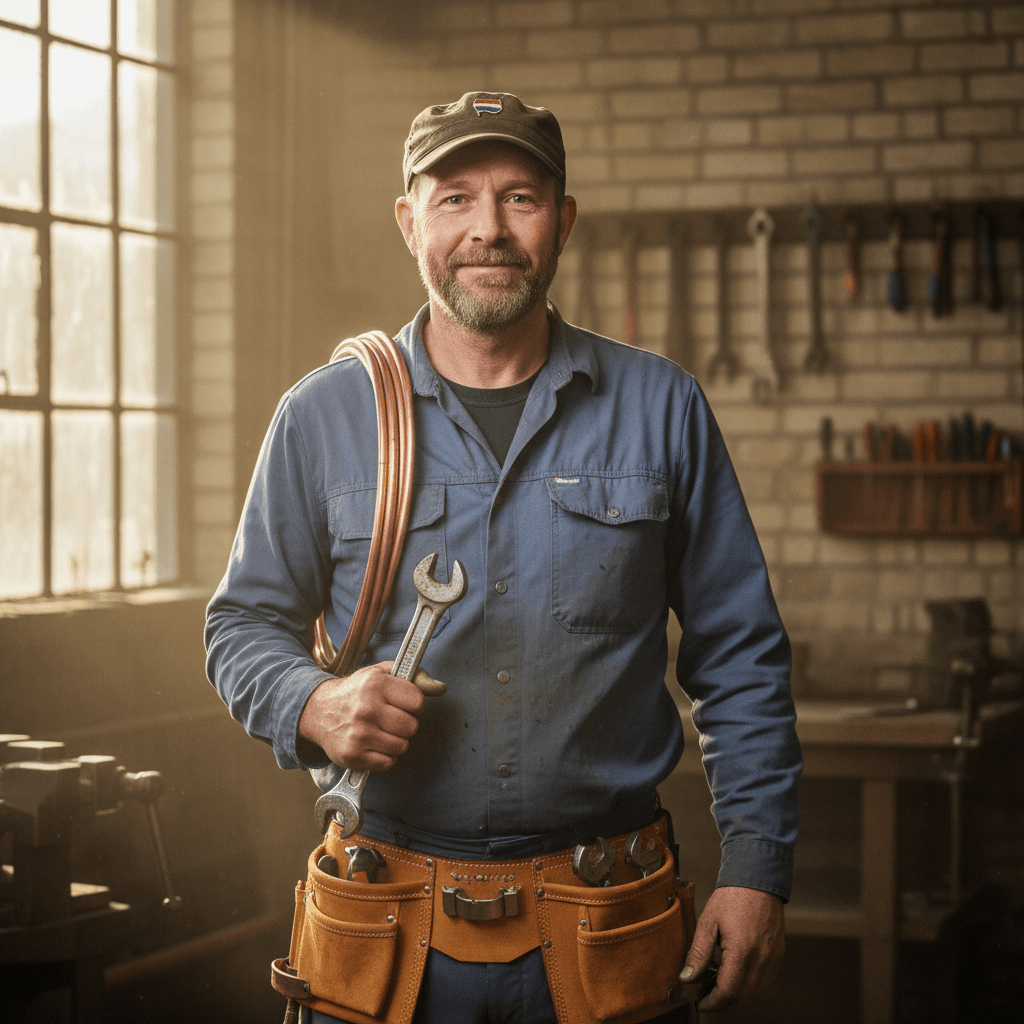
Rob(39)
Enschede → Münster
I'm a plumber — or as they say in Germany: Klempner or Installateur. For fifteen years I had my own business in Enschede, but competition was fierce and margins thin. In Münster, just across the border, Handwerker earned considerably more. The demand for skilled workers in Germany is enormous — you hear the word Fachkräftemangel (skilled worker shortage) everywhere. I decided to make the switch.
The big shock: in Germany many trades are Meisterpflichtig. That means you need a Meisterbrief to work independently as a plumber. My Dutch trade diploma was not automatically recognized. I had to have my qualifications assessed by the Handwerkskammer Münster. After a file analysis and a practical test my diploma was equated to the German Gesellenbrief (journeyman certificate), but not to the Meisterbrief.
To work independently I had two options: take the Meisterprüfung (a 1-2 year program costing about €8,000) or apply for an Ausnahmebewilligung (exception permit). With 15 years of work experience I qualified for the Ausnahmebewilligung. After four months, three dossiers and a personal interview at the Handwerkskammer I received the permit. It was a bureaucratic marathon, but it's possible.
Financially the switch was a good move. As an independent Installateur in Münster I charge €65-€75 per hour — in Enschede it was €45-€55. Demand is huge: I have a three-week waiting list. The Gewerbe registration cost €50 at the Gewerbeamt, and mandatory Handwerkskammer membership costs €250 per year. Additionally I pay Berufsgenossenschaft premiums and took out a Berufshaftpflichtversicherung (professional liability insurance).
The Handwerkskammer isn't just a hurdle — it's also a support system. They offer networking events, continuing education and help finding clients. Through the Handwerkskammer I set up a partnership with a local Heizungsbauer (heating installer). In Germany tradespeople are respected — a Meister is addressed as "Meister" and has social status comparable to an engineer. That's a breath of fresh air after the Netherlands, where tradespeople are often seen as second-class.
Münster is a great city: Germany's number one cycling city, a cozy Altstadt, and the university brings life to the city. My Zweizimmerwohnung in Gievenbeck costs €720 warm. The only downside: the German tax system for self-employed is complicated. You pay Einkommensteuer, Gewerbesteuer and Umsatzsteuer, and the Vorauszahlungen (preliminary assessments) are based on your estimated profit. A good Steuerberater isn't optional — it's mandatory for your sanity.
Highlights
- Meisterpflichtige trades: Meisterbrief or Ausnahmebewilligung needed
- Handwerkskammer evaluates foreign trade diplomas
- Hourly rate as Installateur: €65-€75 vs. €45-€55 in Netherlands
- Fachkräftemangel: huge demand for skilled workers in Germany
Other stories
Marco
Venlo → Düsseldorf
As a nurse I had been commuting across the border for years. When I decided to actually move to Düsseldorf, the real paperwork began.

Niels
Amsterdam → Berlijn
Amsterdam rent prices drove me away. Berlin offered a startup job, an affordable apartment and a vibrant nightlife.
Dennis & Laura
Arnhem → Kleve
With three children we moved from Arnhem to Kleve. A bigger house, Kindergeld and a Grundschule around the corner — but the German school system took some getting used to.