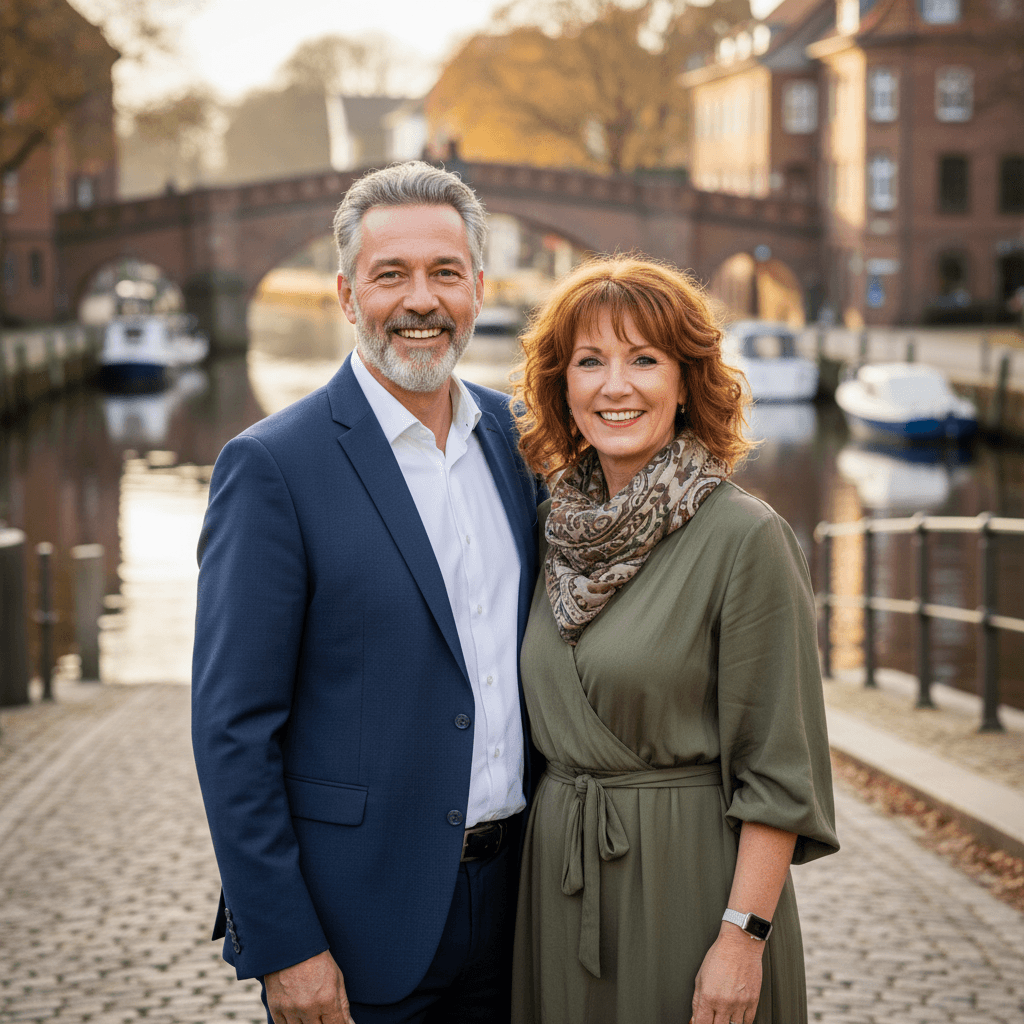
Erik & Diana(58)
Zwolle → Schleswig
Diana and I ran a bed & breakfast in Zwolle for fifteen years. We always dreamed of something bigger, in a more beautiful setting. When on vacation in Schleswig-Holstein we saw a guesthouse for sale — a beautiful Jugendstil building with six rooms on the Schlei — we knew immediately. We sold our B&B, took a mortgage with the Sparkasse and took the leap.
Purchasing a hospitality property in Germany is more complex than a residential home. Besides the usual Grunderwerbsteuer (6.5% in Schleswig-Holstein), Notar and Grundbuch costs, I had to apply for a Gaststättenerlaubnis (hospitality license) from the municipality. That required a Führungszeugnis (certificate of good conduct), an Unbedenklichkeitsbescheinigung from the Finanzamt (proof you have no tax debt), and a Gesundheitszeugnis (health certificate) from the Gesundheitsamt.
The IHK (Industrie- und Handelskammer) and the Handwerkskammer also came into play. As a hospitality entrepreneur I had to register with the IHK and complete a two-day Gaststättenunterrichtung (hospitality training) — a course on hygiene regulations, labor law and fire safety. Cost: €180. The Handwerkskammer was relevant because we were also doing minor renovations to the property. In Germany you can only perform certain trades with a Meisterbrief (master craftsman certificate) or through a certified Handwerker.
The Gewerbe registration as a hospitality entrepreneur went through the Gewerbeamt. Additionally I had to register with the Berufsgenossenschaft (BGN) for hospitality — the mandatory occupational accident insurance. The premium is calculated based on your payroll and industry risk. For a guesthouse with two part-time employees I pay about €1,200 per year in BGN premiums.
Schleswig-Holstein is a hidden gem. The Schlei — a fjord-like inlet of the Baltic Sea — is breathtakingly beautiful. In summer German and Danish tourists come for sailing, cycling and the Viking museum in Haithabu. Our guesthouse does well from April to October. In winter months it's quiet, but we use that time for maintenance and planning. The local population is warm — Schleswig-Holsteiners are down-to-earth and direct, comparable to the Dutch.
Financially the guesthouse is a success. After deducting all costs — mortgage, staff, Betriebskosten, insurance — we keep more net than with our B&B in Zwolle. The Einkommensteuer is comparable to the Netherlands, but the Gewerbesteuer (trade tax) is additional — in Schleswig the municipality charges a Hebesatz of 340%, which amounts to about 12% effective Gewerbesteuer. A Steuerberater is indispensable. My advice: if you have a hospitality dream, look at northern Germany. Prices are lower than in the Netherlands, nature is beautiful and the tourist flow is reliable.
Highlights
- Gaststättenerlaubnis requires Führungszeugnis and Gesundheitszeugnis
- IHK Gaststättenunterrichtung: 2-day mandatory hospitality course
- Berufsgenossenschaft (BGN): mandatory occupational accident insurance
- Gewerbesteuer with Hebesatz: ~12% additional trade tax
Other stories
Marco
Venlo → Düsseldorf
As a nurse I had been commuting across the border for years. When I decided to actually move to Düsseldorf, the real paperwork began.

Niels
Amsterdam → Berlijn
Amsterdam rent prices drove me away. Berlin offered a startup job, an affordable apartment and a vibrant nightlife.
Dennis & Laura
Arnhem → Kleve
With three children we moved from Arnhem to Kleve. A bigger house, Kindergeld and a Grundschule around the corner — but the German school system took some getting used to.